Why Electric Torque Feels So Different (And Why the Numbers Look Wrong)
LEKI quotes 220 Nm and 340 Nm. A 300cc petrol bike quotes 28 Nm. Both numbers are honest. Here is why they are measured differently, and what it means when you ride.
If you have looked at an electric motorcycle spec sheet and thought those torque numbers cannot be right, you are not alone. It is the single most common question we get, and it is a fair one.
LEKI quotes 220 Nm on the 5 kW Bolt and 340 Nm on the 10 kW Surge. A 300cc petrol bike quotes somewhere around 25 to 30 Nm. On the face of it, that looks like a twelvefold difference, which would be absurd.
It is not absurd. It is a measurement point. Both numbers are honest, they are just taken from different places on the bike, and once you know where, the whole thing stops being confusing and starts being useful.
Power and torque, plainly
Power (kW) is how much total work the bike can do. It sets your top speed and your ability to hold it.
Torque (Nm) is how hard the bike pulls when you open the throttle. It sets how the bike feels.
LEKI runs two power outputs: 5 kW on the Bolt and 10 kW on the Surge, with 12.3 kW peak. In pure power terms that puts them in the same conversation as 125cc to 400cc petrol bikes. Ride one and it does not feel like that conversation at all. The reason is entirely in the second number.
Where petrol measures torque
A petrol bike quotes torque at the crankshaft, and it quotes the peak, which sits somewhere high in the rev range.
That number then has to travel. It goes through the clutch, through the gearbox, through primary and final drive gearing, and every one of those stages multiplies it before it reaches the road. First gear on a small-capacity bike might multiply crank torque by a factor of ten or more. So a 300cc bike quoting 28 Nm is putting far more than 28 Nm at the contact patch when it launches.
That is why the gearbox exists. Combustion engines make almost nothing at idle and only reach their peak in a narrow band, so a stack of gears is needed to keep the engine inside that band while the bike changes speed. Riders got so used to managing this that it stopped feeling like management. It is still management.
Where electric measures it
An electric motor makes maximum torque at zero rpm. Not near zero, at zero. Standing still, before you have moved, the full figure is available.
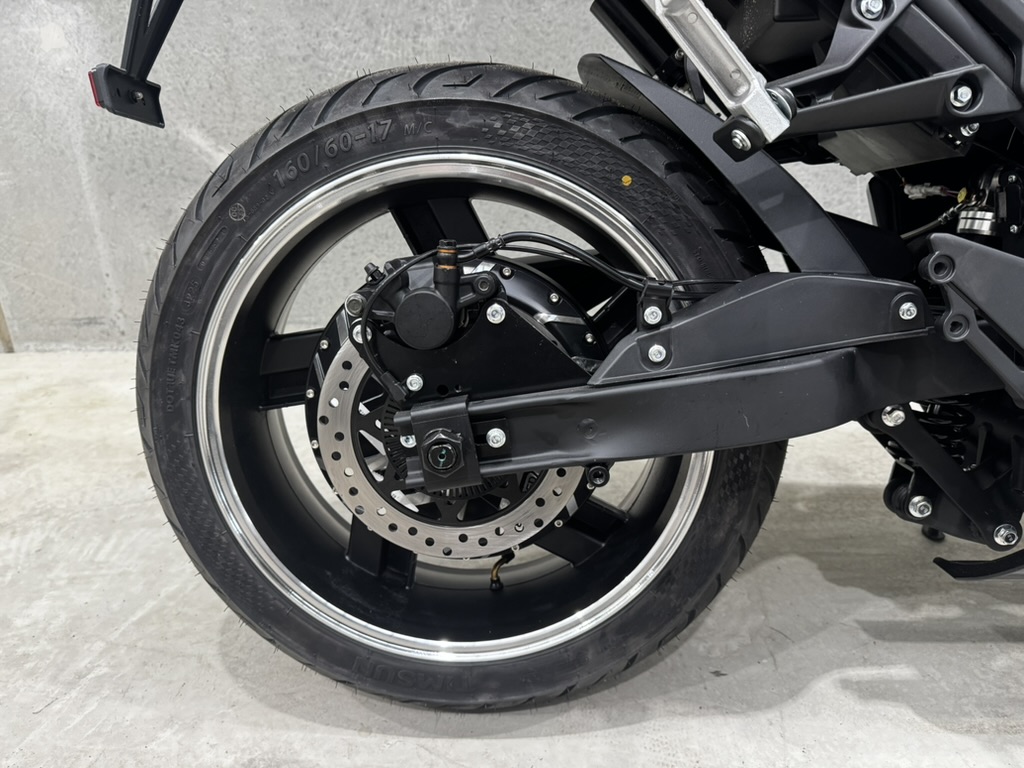
Because there is nothing to multiply and no band to stay inside, a LEKI runs direct drive, single speed. There is no clutch and no gearbox. On the Surge, the motor drives the hub directly, and the number on the spec sheet is what arrives at the wheel: 340 Nm at the wheel, published that way on our own spec sheet.
Different measurement point. Same physics. Very different feeling.
Worth being precise here, because precision is the point of the article: our published spec lists 340 Nm at the wheel. If you have seen it described elsewhere as motor torque, treat the spec sheet as the authority. On a direct-drive hub motor those two figures sit far closer together than they do on any geared bike, but they are not the same claim, and we would rather be pedantic than loose.
What that means at the lights
Here is the practical translation.
A petrol bike has to build. You feed the clutch, the revs climb, the engine reaches the part of its range where it actually makes torque, and then the bike goes. All of it is fast and most of it is habit, but there is a sequence, and the sequence takes time.
A LEKI does not have a sequence. You twist, and the full pull is there in the same instant. Nothing to select, nothing to slip, nothing to wait for.
- The bike leaves the line cleanly and immediately
- Acceleration is one continuous surge rather than a series of steps
- Stop-start traffic stops being work
- The pull between 0 and 80 km/h, which is where nearly all real riding happens, is stronger than the power figure suggests
- The Surge does 0 to 50 km/h in about 2.4 seconds
Around town and on a commute, a LEKI feels stronger than petrol bikes of considerably larger capacity. Not because we have cheated a number, but because the number does not have to travel anywhere to reach you.
The honest limit
Torque from zero is a low and mid-speed advantage. It is the right advantage for the riding most Australians actually do, and we would rather say what it is than imply it is everything.
Power still governs the top end. The Surge tops out at 170 km/h and holds highway speeds comfortably, but sustained high-speed touring is where petrol's endurance still holds an edge, mostly because of refuelling rather than performance. That is a real limitation and we will keep saying so.
About that video
You may have seen a clip of a LEKI being ridden hard.
It was shared to show the bike and the technology working, not as a road-legal performance claim. Official figures for power, torque, range, top speed and compliance are published on the spec sheet at lekielectric.com and in the brochure, and those documents are the reference. If anything in a video looks like it contradicts them, the spec sheet is right.
We would rather have that stated plainly on our own site than let it sit as a question.
The takeaway
Electric motorcycles do not need revs to feel quick.
Power stays modest and efficient. Torque is instant and, more importantly, usable, because it arrives in the speed range where you actually ride rather than at the top of a range you rarely visit. The result feels effortless instead of aggressive, which is a distinction that only makes sense once you have felt it.
That is really the answer to the whole question. The numbers look strange on paper because they are answering a different question than the petrol numbers are. Ride one and the comparison resolves itself at the first roundabout.